

How Do You Know You Belong?
What is the end point of self-reinvention? How will you know it’s “done”? Will your days be filled with clarity, authenticity, and integrity? Will you have a stronger sense of purpose or fulfillment? Will your decisions and moves be more intentional, more inspired? Will you find “home” in yourself, rather than in your new place?
I think a fair answer would be, “Maybe.”
When Kathy and I started the Relocurious project, our curiosity about people’s experiences of relocating made us wonder whether big moves share a common trajectory: Does it matter what sparks the move, whether we like the idea of moving, or at what stage of life we are relocating? How do thoughts and emotions work together when we embark on a big life change? Do the familiar stages of change (precontemplation, contemplation, preparation, action, and maintenance) apply?
We are far from having the answers figured out, and maybe “having all the answers” is not what this quest is about. Our experiences, the stories we tell, and how happy or satisfied or fulfilled we feel as a result of moving all influence who we are becoming.
If you never move, your life will be affected by the people, interactions, and events around you. And just the same is true if, like us, you do move — except now you have stirred up the people, interactions, and events. You have added variety, perhaps novelty, and you have changed how predictable everything is, for better or worse.
Exposing ourselves to a broader range of histories, challenges, sceneries is bound to expand our horizons, encounters, and the world’s reflection inside us. By changing “our world” so much, we are bound to end up being reinvented, whether or not that had ever been our plan. The real question is, how “OK” are we with that being so?
The Relocation Arc
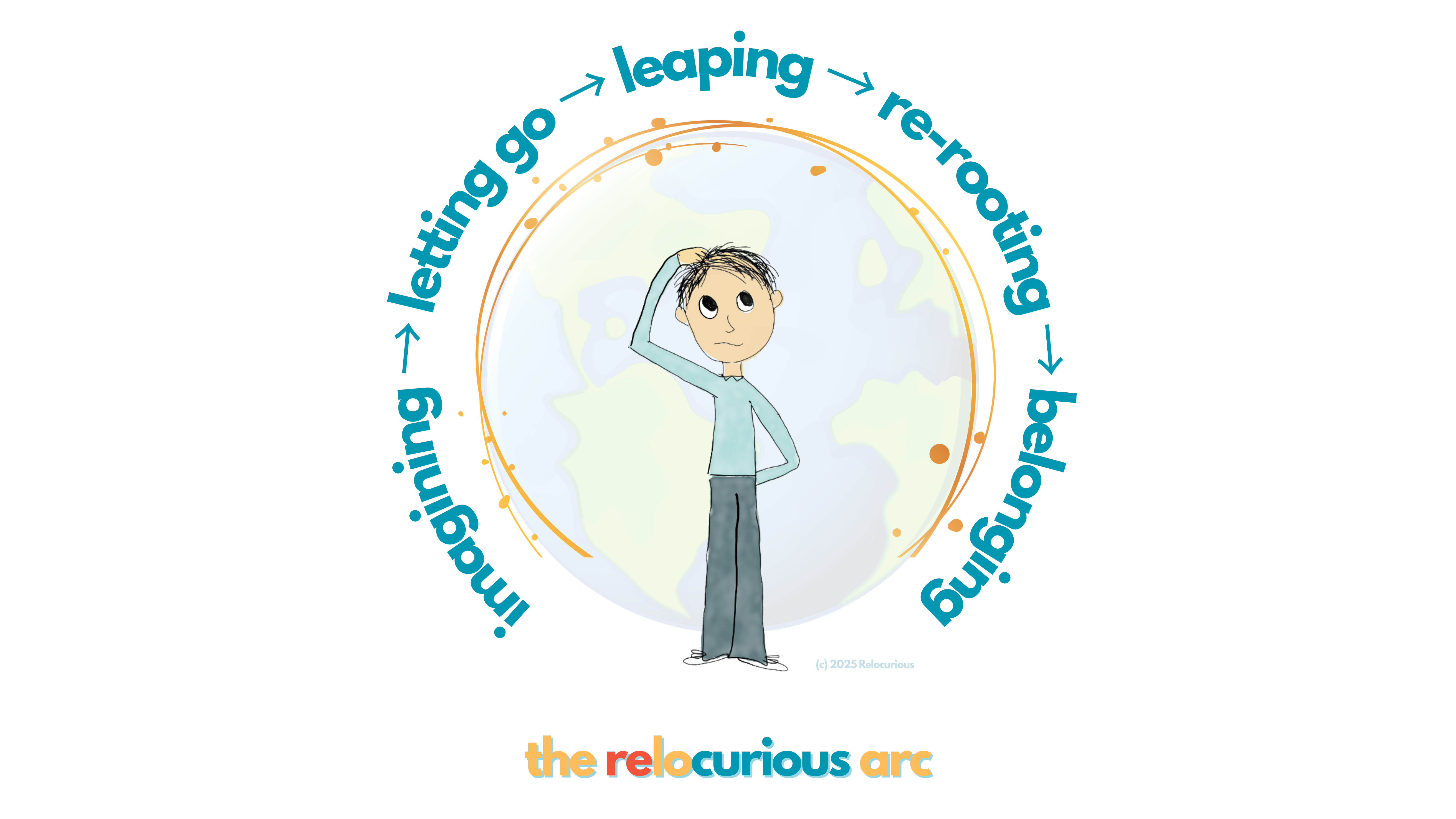
Since we shared the idea of moves unfolding along an arc that connects imagining, letting go, leaping, re-rooting, and ultimately belonging, we have had a ton to reflect on. Our podcast guests have been generously sharing stories filled with excitement, worry, looking forward, looking back, packing, unpacking, grieving, being disoriented, making new connections, feeling at home again, or not yet, or never, or not anymore.
The five stages may resonate, though the progression may not be linear: There may be some back-and-forth. What we had thought would be a later stage may come on the scene earlier on. Or, you just can’t imagine a particular stage ever being over. You may never be done imagining; moving may become a lifelong quest of discovering the world (and yourself). Thinking of letting go, can you ever really say goodbye to everything and everyone and everywhere that ever mattered to you? Then there is leaping, which surely is “done” the moment you get off your flight and arrive in your new place — but have you truly never had a second thought about it all? Next is re-rooting: gradually embracing the language, culture, and customs of your new place … where you come to suspect there is always going to be more to discover, and work through, and accept.
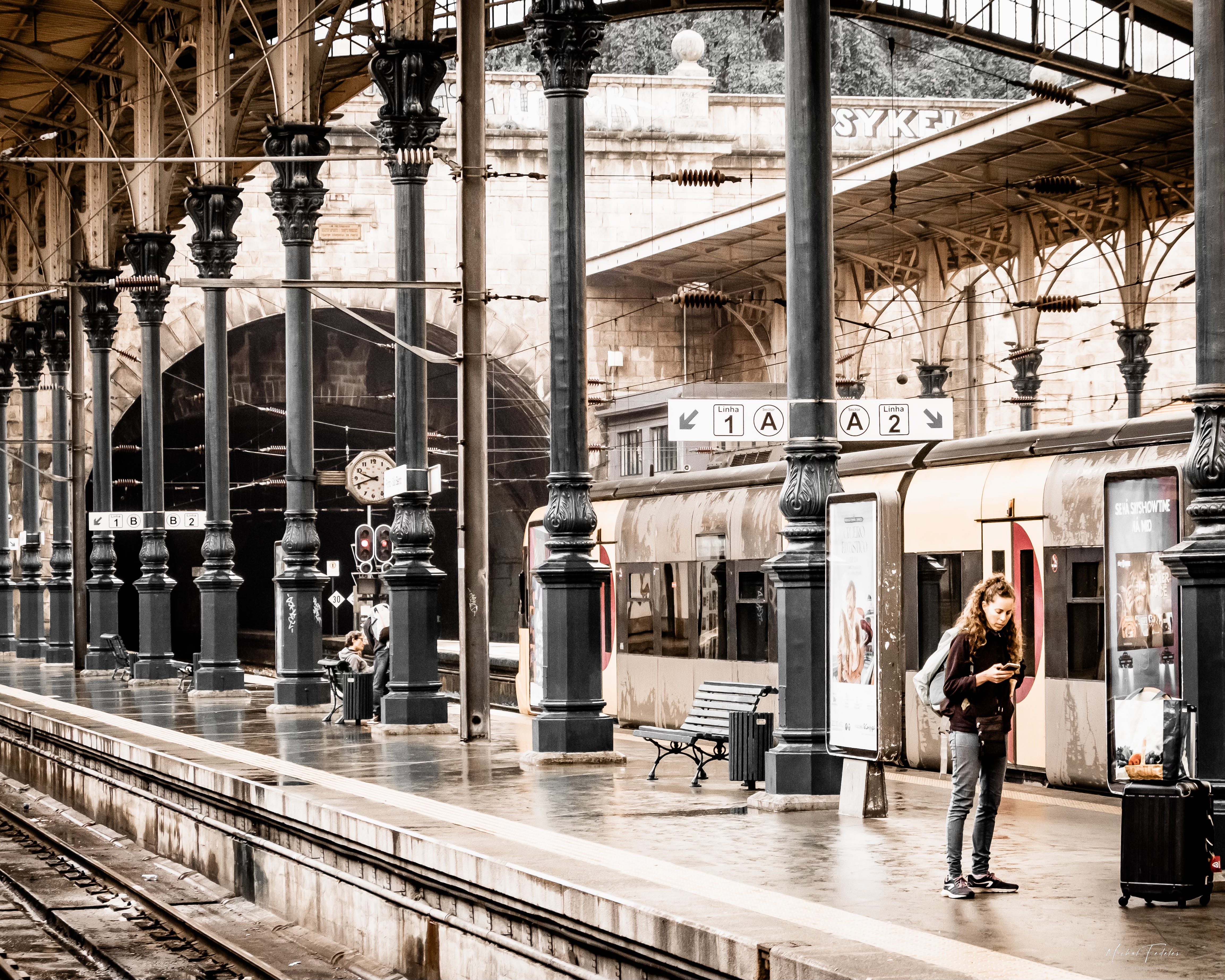
And finally, there is the stage of relocating we call belonging. The trickiest of them all, I suspect. Why? Well, on one level, Portugal offered such a friendly and welcoming vibe, we instantly felt a connection. It immediately seemed “right” to be here, like we belonged. Or, maybe we just really wanted to feel that way. But do we truly belong, or will we ever? Would everyone around us say we do? How much does that not matter?
On our first visit to Porto, we had a long conversation with two local guys over beers. They were proud of their city in such an unexpectedly inclusive way. Their parting words were: “This is a good place. You should move here.” That was our first evidence that belonging here was possible. Fast forward a couple of years, a doctor at a blood clinic offered further evidence when she said, “Portugal needs more people like you.” That “like you” sounded a tad conditional, but just as sincere, warm, and encouraging.
At our favourite local restaurant, brothers Helder and Ricardo always welcome us with big smiles and handshakes. Not just us: Virtually everyone who comes is greeted warmly and with that spark in the eye that conveys you are among friends. Seeing other guests treated to hugs doesn’t negate our experience of belonging; it enhances the sense that this is a community that everyone, us including, is a part of.
The Way to Belonging
So perhaps rather than expecting to arrive at belonging as a final destination, we could think of it as a felt experience that emerges over time. It has to do with how we relate to place, people, purpose, and very much to our sense of self as well — all of which have been evolving and reshaping since Act 1. That way, belonging is neither something we claim nor something afforded to us by a country or community. It simply grows from the interplay of who we are becoming, and how we show up in life. How do you see it?
You have arrived in the physical sense, yet it likely feels like you are still arriving in other regards. Your new roots are growing stronger — but how you weather storms remains uncertain. You may feel capable of living here, but how you actually fare may depend not just on you: Further ambiguity, grief, and self-discovery are inevitable, just as there may be further identity shifts to work through on your way to belonging.
Signs You Are Beginning to Belong
The more of the following statements resonate, the farther along you are on your way to belonging:
You are using comparison statements about “how things were back home” less and less.
You are choosing your new circles of friends, interests, and routines with intention.
Your identity — how you see yourself — stretches beyond national or cultural borders.
You are enjoying — even to the extent of protecting — the quirks of the new place.
You are more relaxed about sharing with family and friends how your new life really is.
You catch yourself thinking: This life is shaping me in ways I welcome and appreciate.
You become the one who gives directions to a tourist (and you dwell in the satisfaction).
The server at your corner café greets you by name, and remembers your order.
A bureaucratic process still puzzles you but no longer throws you off or annoys you.
Your language mistakes turn from shameful to funny.
How Is Belonging Reconstructing Your Identity?
As you take daily steps towards belonging, the big question on your mind shifts from “Do I belong here?” to “How do I choose to belong?” Where are the following questions taking your mind as you keep reinventing yourself?
Where are you in the liminal space between “you back then” and who you are becoming?
What is your next move towards the self-authored you, free from others’ expectations?
Are you ready to tell a story of your life that honours both worlds without conflict?
Have you been noticing gentle shifts in what you honour, protect, and invest in?
What curiosity, contribution, and co-creation are you bringing to your new place?
The Sense of Home
A big move and the growing feeling of belonging can shift the perspective of where “home” is. Becoming a part of your new community or culture does not erase the old ones; they get integrated into who you are and how you think of “home”. You find yourself more grateful for where you came from, and more compassionate for the earlier editions of you. You catch yourself speaking of “love” for both your previous and current homes and communities. The tension between the old and the new eases.
Over time, as you discover and experiment with new perspectives, you grow more adaptable, curious, and tolerant of ambiguity. And as your sense of self settles, you may notice your mind shifting from asking questions like, “Who am I becoming due to this move?” towards a more communal perspective: “Who am I now able to be for others?”
Gratitude and Intention
You have made the journey from imagining all the way to belonging again, all the while reinventing or transforming yourself. When you are ready, here are a few more questions for even deeper reflection:
What aspects of who I am have expanded in this new place? How come?
What have I learned about who I am, with the familiar and comfortable stripped away?
What parts of this new life feel unquestionably mine?
In what ways have I contributed to creating the belonging I now feel?
How have I changed — not by force of relocation, but by choice and my own actions?
What is going to be my next step towards who I am ultimately becoming?
What if belonging is not about arriving somewhere, but about arriving to yourself?
Thank you for taking this five-act journey of self-reinvention with us. In the coming weeks, Kathy and I are planning to explore how we experience “home” when we move. We would love to hear your perspective and your story: By email, phone, or over coffee (we like coffee!).